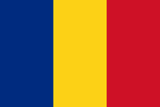
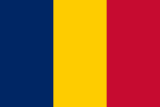
At a sports match, in the UN General Assembly hall, or among the pages of a geography book — when you see three vertical stripes of blue, yellow, and red, which country comes to mind first? Romania, or Chad? The answer often depends on where you grew up.
Because we're talking about the two most visually similar national flags in the world — a similarity that, in 2004, escalated into a formal diplomatic incident at the United Nations.
Two Flags, One Design
At first glance they're nearly impossible to tell apart. Both flags are blue, yellow, and red in three equal vertical stripes. Same 2:3 aspect ratio. Same yellow (Pantone 116 C). Same red (Pantone 186 C).
The only technical difference? The shade of blue.
- Romania:
#002B7F— slightly lighter - Chad:
#002664— slightly darker
Detecting the difference essentially requires a Pantone book. With the naked eye under normal lighting it is nearly invisible — and when a Romanian flag is faded or blowing in the wind from a distance, the blue drifts even closer to Chad's.
Two Origins: 1848 and 1959
Romania: Born in the Streets of Revolution
Romania's tricolor was born in Bucharest during the Revolutions of 1848. Revolutionaries in Wallachia and Moldavia, inspired by the French tricolor, fused three colors that were not chosen at random: blue-yellow were the traditional colors of Wallachia, red-yellow those of Moldavia. Combining them was a symbol of unification — an ideal realized in 1859 when Alexandru Ioan Cuza was elected prince of both principalities.
Between 1948 and 1989 the flag carried the communist coat of arms. One of the most iconic images of the December 1989 revolution shows Romanians cutting the emblem out of the center with scissors. Flags with a hole in the middle became the revolution's most powerful symbol. On 27 December 1989, the plain tricolor was restored as the official flag, returning to its 1848 form.
Chad: Designed on the Eve of Independence
Chad's flag was adopted on 6 November 1959, about nine months before independence from France. The design was openly inspired by the French tricolor's vertical stripe layout — a common choice among former French colonies — but the colors told a story of Chad's own geography.
- Blue: the southern sky, water, and hope
- Yellow: the sands and sun of the Sahara to the north
- Red: blood shed in the struggle for independence and national unity
Yellow stands as a reconciling middle — the symbol of the Sahel transition zone between the Muslim-majority north and the Christian/animist south. The flag is also a geographic map of the country.
Same Colors, Different Stories
The same three colors carry entirely different meanings in the two flags:
- Blue — Romania: liberty, sky, traditional Moldavian color. Chad: southern sky, water, hope.
- Yellow — Romania: justice, wheat fields, Wallachia–Moldavia unity. Chad: Saharan sands, sun, the Sahel.
- Red — Romania: brotherhood, the martyrs of independence, Wallachia. Chad: the blood of independence, national unity.
Two flags can look identical and still evoke completely different things. The same picture, two different poems.
2004: The Flag Goes to the UN
The resemblance had been debated for decades, but in 2004 it became an official diplomatic dispute. Chad's then-president Idriss Déby raised the issue at the UN General Assembly and asked Romania to change its flag, arguing that Chad's flag had been adopted in 1959 while modern Romania's emblem-less tricolor was only made official in 1989.
Romanian president Ion Iliescu firmly refused. His reply was historical: "We have used these colors since 1848. The historical priority is ours." The UN issued no ruling. The matter remains unresolved to this day — a rare case of a flag-similarity dispute formally raised before the UN.
Is There a Vexillological Rule Against "Same Flags"?
Short answer: no. There is no international rule explicitly prohibiting it. Distinctiveness is one of NAVA's five principles of good flag design — but that's a recommendation, not a binding standard.
And Romania-Chad isn't the only "flag twin" pair. A few others:
- Indonesia - Monaco: red-white horizontal stripes; only the aspect ratio differs.
- Netherlands - Luxembourg: red-white-blue horizontal stripes; Luxembourg's blue is slightly lighter.
- Mali - Senegal - Guinea: green-yellow-red vertical stripes; only the order changes.
Which Is Which?
A practical tip: context matters. A consulate in Bucharest? Romania. A government building in N'Djamena? Chad. At the Olympics? Just read the label.
But a brief pause during a UEFA night, an Africa Cup photo, or UN General Assembly footage is entirely understandable. Two nations, on different continents, having never historically interacted, share the same visual signature.
Perhaps that's the most beautiful paradox of flags: meaning lives not in the image, but in the story we attach to it.