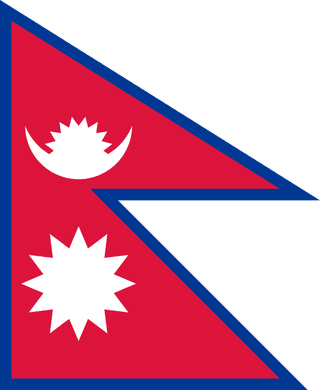
Of the world's 195 independent countries, all but one use a rectangular flag. Nepal stands as the sole exception with its flag formed by two stacked triangular pennons. This unusual shape is not a design caprice; it is the deliberate synthesis of Himalayan geography, Hindu-Buddhist tradition, and the centuries-old vexillological heritage of the Rana dynasty.
Double Pennon: Two Banners United in One Flag
The official name of Nepal's flag literally means "double crimson pennon." A pennon in European heraldic tradition refers to the triangular banners knights attached to their lances, but in Nepal the same form has an entirely different origin. In the 19th century, the two branches of the Rana dynasty's prime ministers used separate triangular pennons — one bearing the sun, the other the moon. In 1962, with the new constitution, these two banners were merged into a single flag: the upper triangle holding the moon, the lower triangle the sun.
Geometry of Geography: A Symbolic Mirror of the Himalayas
Nepal hosts 8 of the world's 14 highest peaks. The flag's two stacked triangles are a direct stylization of this geography: two Himalayan summits rising sharply against the horizon. The form simultaneously symbolizes the two principal religious traditions — Hinduism and Buddhism — that have coexisted in Nepal for centuries.
Symbols and Colors
The flag's crimson field echoes the color of Nepal's national flower, the rhododendron, and traditionally signifies courage. The blue border represents peace. The crescent moon in the upper triangle symbolizes the royal house and serene governance; the sun in the lower triangle stands for resilience. Together they convey the most powerful diplomatic message the flag carries: "Nepal shall endure as long as the sun and the moon."
Constitutional Geometry
Nepal's flag is the only national flag in the world whose construction is mathematically prescribed in the constitution itself. The 1962 constitution's appendix specifies, in 24 numbered clauses, exactly how each line is drawn with compass and ruler. This procedure exists because the asymmetric form makes standard aspect ratios meaningless — the height-to-width ratio of approximately 1.219:1 is not chosen but derived from the triangle geometry.
Why It Remains the Only One
Other nations standardized their historic forms under the Westphalian state system; Nepal alone preserved its traditional shape and forced modern protocol to make room for it. Beyond aesthetics, the flag is a manifesto of cultural resilience against globalizing pressures of uniformity.